See How Modern ERP Systems Reduce Supplier Risk Exposure
Many supplier control gaps aren't procedural - they are systematic. Disconnected systems, manual tracking and siloed quality data make it difficult to demonstrate control during inspection.
If you're evaluating how your ERP supports supplier visibility, complete the form below and we will share how manufacturers are strengthening oversight through integrated systems.
Medical Devices Regulated by
The US Food & Drug Administration
Medical Device Companies
Operating in the US
Estimated Annual Cost of
Non-Routine Quality Events
See Where Supplier Controls Create Hidden Risk
Recent FDA enforcement trends show how supplier and outsourcing decisions can quietly expand regulatory exposure across complaints, CAPA, and risk management. Explore where gaps most often emerge - and what regulators now expect to see.
-
Supplier Controls Are Under Increased FDA Scrutiny
Supplier controls have always been a regulatory requirement - but recent FDA warning letters show increased scrutiny on how those controls are applied in practice. Inspectors are looking beyond documented procedures to evaluate whether organizations can demonstrate risk-based oversight, ongoing monitoring, and meaningful control over suppliers and outsourced services.
-
Outsourced Services Are No Longer A Blind Spot
FDA enforcement trends make clear that services affecting quality outputs - such as complaint handling, MDR assessment, sterilization oversight, or software maintenance - are subject to purchasing controls. When these services are not formally evaluated and controlled, regulatory exposure often appears downstream in complaints and CAPA.

-
"Approved Supplier" Status Is No Longer Enough
Approval alone does not demonstrate control. FDA increasingly expects manufacturers to define and justify the type and extent of control applied to suppliers based on risk, and to show evidence that those controls are implemented, monitored, and reassessed when conditions change.
-
Supplier Changes Create Retrospective Risk
When supplier changes occur without formal reassessment, organizations may inherit retrospective exposure - including distributed product risk. FDA has signaled through enforcement that CAPA responses must address not only procedural gaps, but whether past product or patient risk was affected.
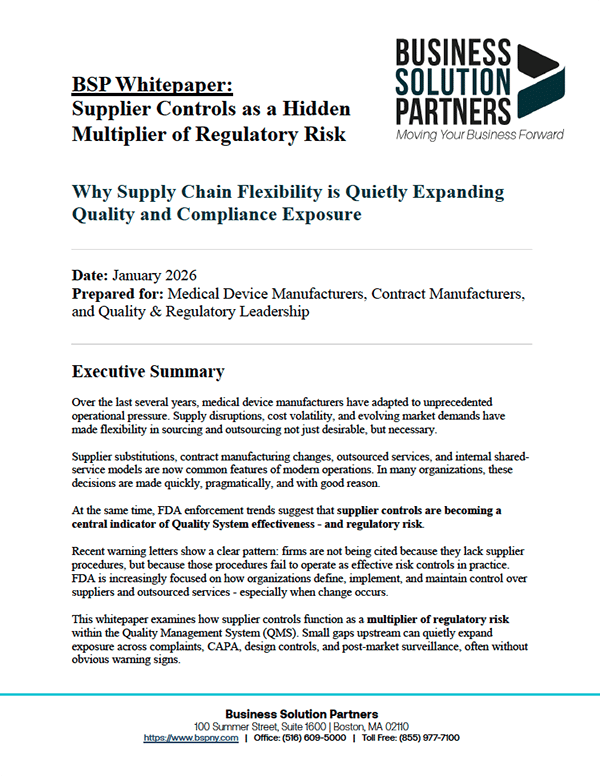
Are Your Supplier Controls Reducing Risk - Or Quietly Expanding It?
Supplier controls are no longer a background compliance activity. FDA enforcement trends suggest they are being evaluated as a core indicator of Quality Systems effectiveness.
Our white paper helps Medical Device Manufacturers understand where supplier-related risk may be accumulating - and how to assess whether controls are functioning as intended under today's enforcement reality.
Live From The Floor
of MD&M West
Cloud ERP, Compliance & AI: What's Next for MedTech?
Original Broadcast Date: Feb. 4, 2026
Recorded live at MD&M West 2026, Business Solution Partners shares how medical device companies are modernizing ERP - moving to the cloud, embedding quality natively, and leveraging AI - without compromising compliance or traceability.
BSP Solution Architect Joe Harmer, and Account Executive Morgan Mizuer, sit down with Hybrid Technology Manufacturing Global Chief Revenue Officer and News & Brews Co-Host Lisa Block sit down to discuss ERP in the Medical Device Space.
Trusted by Quality Leaders in Regulated Industries
Medical device manufacturers rely on Business Solution Partners to strengthen supplier controls and reduce regulatory risk.
When Supplier Risk Meets System Fragmentation, Inspection Confidence Erodes
Most supplier control gaps aren't caused by missing procedures - they're caused by disconnected systems, manual tracking and limited visibility across quality and operations.
If your organization is evaluating how well your ERP supports supplier oversight, now is the time to examine whether your systems reflect your current operational reality.
Complete the form below to continue the conversation with our team of experts...